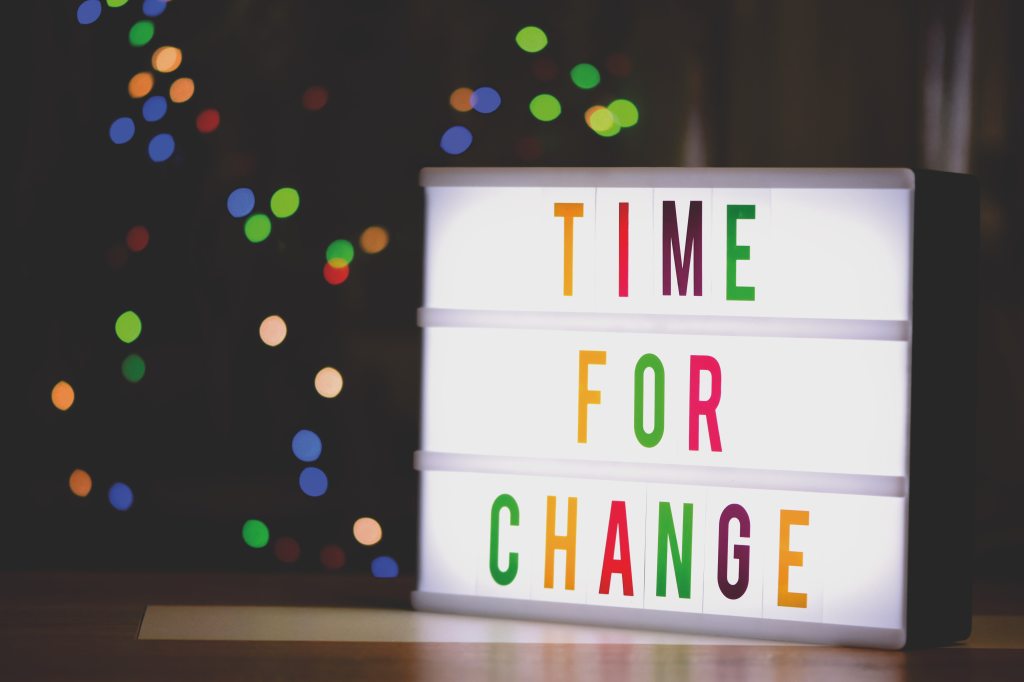
As college students and people in general, we never stop changing and dealing with change. We start off as freshmans who come in new to things and are somewhat fearful of the unknown and then end up as seniors who are about to start a new change which is going into the workforce. Life is all about change and we see that a lot personally as college students.
In one of my previous blog posts, “Switching to Online Classes: 5 Ways to Adapt & the Mental Effects,” I discuss what the particular change of switching to online classes has had on college students and mainly how to adapt being a college student during times like these. But this post is all about change as a whole from a college student to another college student and is going to dive in on what it truly does to our brains.
What is Change?
First off, let’s start by defining what change is. According to yourdictionary, change is the act of becoming different or replacing one thing for another. Of course we all have different definitions of what change can be, but that’s the dictionary version. Now what’s the point of this? The point is that rather we want to admit it or not, change can have significant effects on our brains and how we function. I believe that that’s one of the words humans fear most, is change because with change comes new and the unknown.
Change can be both small and big, but it has similar effects on everyone. Rather it is transferring to a new school, a break up, getting in a car wreck, losing a loved one, moving houses; it all plays a part in how we function. It’s coming to terms with change is what truly is the hardest and most difficult, and that is something we must face as humans.
Its Effects on the Brain
According to Carol Kinsey Goman, a business and leadership expert, she explains that a lot of our day to day habits are controlled by a part of our brain called the basal ganglia. With the tasks we normally do, it takes less energy mentally because we’re so used to doing them, we feel comfortable. Who the heck doesn’t like feeling comfortable and in control? Change does what we don’t like, it takes us out of that comfortability. Goman explains that because change takes us out of our comfort zones it stimulates the prefrontal cortex which is linked to the amygdala which is the brain’s fear circuitry and controls the “flight or fight” response.
“When the prefrontal cortex is overwhelmed with complex and unfamiliar concepts, the amygdala connection gets kicked into high gear. All of us are then subject to the physical and psychological disorientation and pain that can manifest in anxiety, fear, depression, sadness, fatigue or anger,” Goman wrote.
In other words, what makes change so difficult on our brains is how much we’ve conditioned them to being fixated on certain things. This is so easy though because we all have our routines and our routines are what helps us have a “normal” life. But with every routine comes more difficulty in the long run.
“Your life does not get better by chance it gets better by change.” -Jim Rohn
According to Cultural Brilliance: The DNA of Organizational Excellence, “This is how neural pathways are laid down in the brain by early experiences then repeated until their edge more deeply even if they don’t work as well. So, to think creatively we have to create new neural pathways outside the cycle of experience and stimulation for a new insight.”
I know a lot of this may be so science-y and hard to comprehend, but we have to have a different and new way of looking at things and change. Ha! I’m a poet and I know it. Anyways, back to more of a serious note, these are just a few of the ways change affects our brains and it’s truly mind blowing and something we may have not ever come to terms with. Sorry for this I know you probably thought we were done, but did you know that there’s different types of change too?
Different Types of Change
Yes, this is something I’m just now learning too while doing research, there are indeed different types of change. If you already knew this sorry, I’m dumb and you can just skip over this part. But wow! Isn’t this crazy? I’m completely mind blown and just shook. There’s a total of 10 different types of changes but I’m just going to give you four of them. This information that I’m providing you with comes from the Management Study Guide and you can definitely click on the link and look at the other five – no six different types of change, see you thought I didn’t know my math there. Anyways, let’s get into it.
1. Happened Change. This is the change where you have your whole day planned out but suddenly you get a call your dog died. This change is known to be unpredictable and traumatic since the consequences are out of your control. This is basically an uncontrollable change, and you can’t do anything about it, sorry to face you with it.
2. Reactive Change. Due to money being really tight around the house because someone got laid off, you’re forced and have no other choice but to get a job. This is the type of change where because of a certain event happening you have to kind of do what needs to be done.
3. Anticipatory change. This type of change is somewhat explained in its name. It’s when we anticipate something happening but it doesn’t go to plan. For example, there may have been some trips planned but because of the coronavirus outbreak they had to get cancelled.
4. Planned change. With this change it’s intentional. It can be personal or toward someone else and is conscious. For example, in your head you’re getting so tired of your boyfriend or girlfriend, therefore you’ve already added up the costs of a breakup and proceed to end things that would fall into the category of planned change.
Now like I said before, these are only four of the 10 but they’re all so good so I would definitely suggest clicking on that site and reading more! Now that we know some of the different types of change and what change does to our brains, we can figure out how to best cope with it. Below I’m going to give you some tips on how to cope with change and trust me, I’m definitely going to take my own advice.
Ways to Cope with Change
1. Instead of resisting, embrace IT! Ugh. I know this sounds so hard to do but it really works because the more we fight against something the worse it could become. Don’t get me wrong, it’s okay to be upset for a while and deal with your different types of emotions, but eventually you’ll have to learn how to embrace change because it’s inevitable. I love this one quote by Alan Watts and he says this, “The only way to make sense out of change is to plunge into it, move with it, and join the dance.”
2. Talk to someone. This can be really helpful and therapeutic especially if you’re really struggling with a certain type of change in your life. Just letting out how you feel and your emotions can be super beneficial for you in the long run.
3. Know that change happens to everyone & you’re never alone. Just know as I’ve said before, we all experience change rather it be big or small, it happens. You’re never alone and never ever think you are because there has been someone going through it before you and someone going through it with you and someone who may go through it after you. Embrace it, talk to someone, and know that it happens.
“The only way to make sense out of change is to plunge into it, move with it, and join the dance.” -Alan Watts
Conclusion
Overall change is crazy but it can turn into something beautiful if you let it. So let us all try to just understand it more and embrace it, because it is indeed inevitable. I believe that part of growing as a uni we have to accept change and that will lead to growth. Remember, “If we don’t change, we don’t grow, we aren’t really living.” -Gail Sheehy And always remember, We got this and will always persevere!
 Healthy Uni